

Teleco_SQL_Tableau_Customer_Project
- znoqamza
- Mar 4, 2025
- 3 min read
Goal
The goal of this project was to analyze customer behavior in a telecom company using SQL and visualize key trends with Tableau to gain deeper insights into customer churn and retention patterns. By identifying the factors influencing churn, the company can implement strategies to reduce customer loss and improve satisfaction. The analysis focused on evaluating how variables such as contract type, internet service, payment methods, and tenure affect customer loyalty. Additionally, the project involved data cleaning and validation to ensure accuracy before performing statistical analysis and visualization.
Process
The analysis started with data cleaning and integrity checks using SQL, where missing values, duplicates, and formatting inconsistencies were identified and addressed. Once the dataset was structured, exploratory queries were executed to examine customer demographics, service preferences, and contract details. SQL was used to segment customers based on tenure, contract type, and churn status, highlighting patterns in retention and loss. To further enhance the understanding of these trends, Tableau was used to create interactive visualizations, such as churn distribution heatmaps, tenure-based retention bar charts, and spending trend line graphs. These visual representations made it easier to identify correlations and actionable insights at a glance.
Insights
The analysis revealed that customers with short tenure (≤1 year) had the highest churn rates, particularly those with month-to-month contracts. This insight, further emphasized by Tableau’s visuals, suggests that offering long-term contract incentives or exclusive retention offers could reduce churn. Tableau also helped visualize data inconsistencies, reinforcing the importance of data quality management for accurate business insights. These findings provide data-driven strategies for the telecom company to optimize its customer retention approach, refine service offerings, and drive long-term revenue growth.


We will now explore the visuals from Tableau:
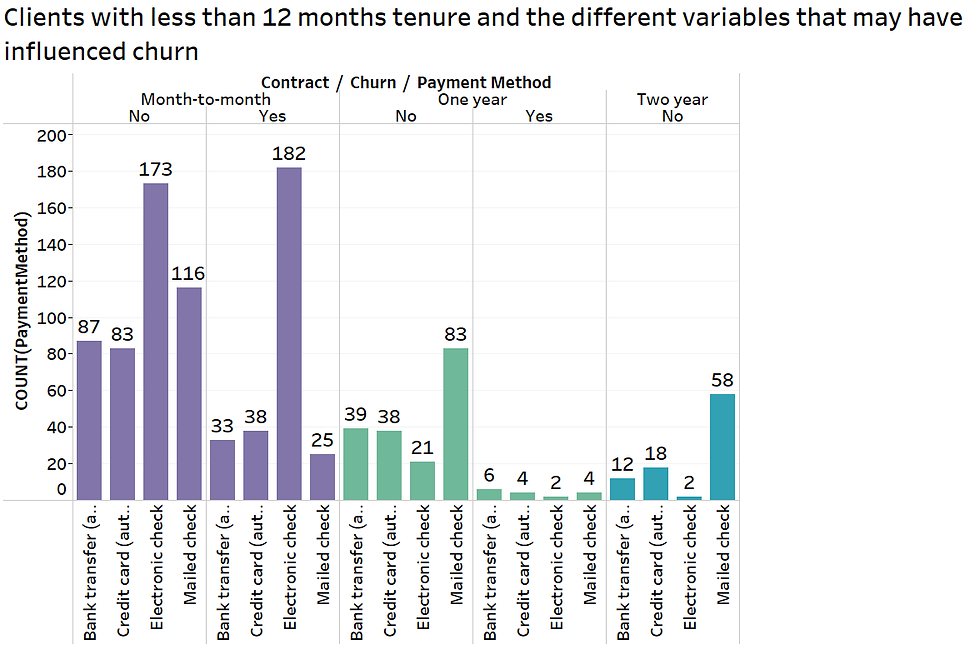
The above graph shows that clients that have month-to-month contracts, electronic and mail check payment method are the highest amount of the clients that had a tenure of less than 12 months.

The above graph shows that the clients that spent between 1 to 2 years with us. Clients that have month-to-month contracts, electronic and mail check payment method are the highest amount of the clients that leave just like those with 12 months or less.

The trend continues with those that spent 2 to 3 years.

The trend continues with the clients that spent between 3 and 4 years with the company. The only difference is a significant increase in clients with 1 and 2 year contracts but had not churned. This shows that some clients did not churn but that their contracts ended for reasons such as the payment being unsuccesful at the bank and therefore leading to the contract ending.
The graph below shows a significant increase in customers that had 2 year contracts but had a tenure of over 4 years which means the contracts renewed automatically for 4 years or more. These clients should also be explored with further data, to find more possible reasons for the clients to departure.

The next graph puts all the customers that spent time with the company into perspective over the whole tenure. We can see that clients that spent 1 year or less and 5 years or more need to be explored with more variables than just the above variables.

The following pie chart further emphasises the need to reduce the month-to-month contracts since most of the clients that leave are on this type of contract.

The following pie charts will give insights into the clients demograhics. These could be further explored upon a stakeholders request.


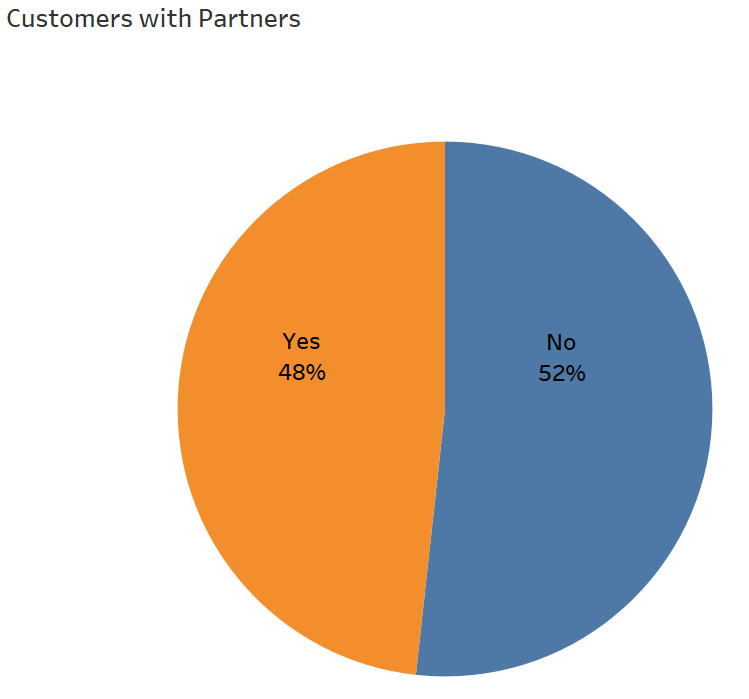


The pie charts showing the demographics with the above graph can be used to see what demographics to develop new products for or to conduct further insights. The graph can especially be used for new business such as upselling Online Security to Avast or any other other online security company



Comments